
How irrigation really works.
Eight parts, one job. Tap through the anatomy of a system, run the bucket test on your own spigot and watch five zones water a yard.
Eight parts, one job.
Tap each numbered part, then run the water to watch it travel from the meter to the heads and drip lines.
Where your water enters. A dedicated or shared meter feeds the system, and the shutoff lets us isolate everything for repairs or winter.
Keeps irrigation water from ever flowing back into your drinking water. Required by code and tested on a schedule your utility sets.
The brain. A smart controller reads the weather and your zone settings, then tells each valve when to open and for how long.
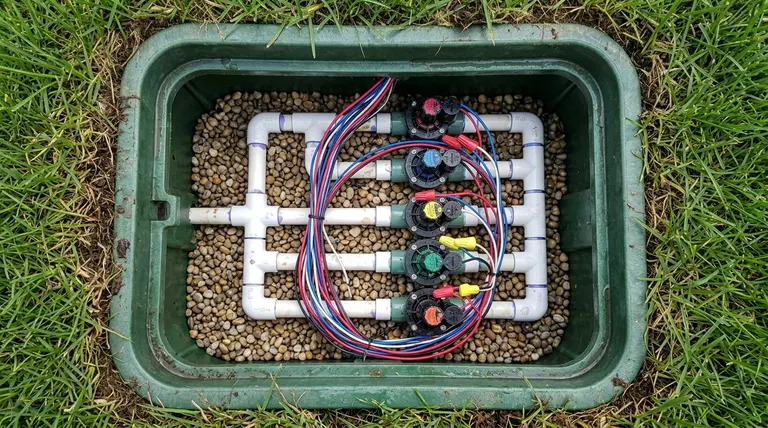
One valve per zone, all together in a box. Each opens on a signal from the controller and sends water to its zone.
The pressurized pipe from the supply to the valves. It is always under pressure, so a break here wastes water fast.
Pipe from each valve out to its heads. It only has water while the zone runs, so leaks here show up as soggy spots.
Pop-up heads that rise when the zone runs. Matched nozzles put water down evenly so every part of the lawn gets the same depth.
Slow, low-pressure watering for beds, trees and gardens. A filter and a pressure regulator protect it.
The bucket test: flow and pressure.
Every good design starts with two numbers. Time a 5-gallon bucket and read a pressure gauge, then see how many heads one zone can carry.
The bucket test
Fill a 5-gallon bucket from an outdoor spigot with the hose off and time it. Check the pressure with a gauge on the same spigot.
- Flow
- Design flow per zone
- Rotors per zone
- Spray heads per zone
Five zones, one morning.
Run the cycle, bring in the rain, or switch to gaps coverage to see what poor design looks like on the lawn.
Run the morning cycle
Five zones, one smart controller. Press play, bring in the rain or switch to gaps coverage and see why design matters.
- Water used
- 0 gal
- Lawn moisture
- Zone now
- None
Pick a zone, or run the whole morning cycle.
The details behind the green.
Measure first
Pressure and flow decide the zone count.
Head-to-head coverage
Overlap so there are no dry stripes.
Match the nozzles
One precipitation rate per zone.
Beds on drip
Roots, not leaves, get the water.
Weather-aware control
A smart controller skips rain and adjusts by season.
Get your number
A free visit turns all of this into one written proposal. Ask for my estimate
How it works: common questions
How many zones will my yard need?
Zones are limited by how much water your supply can deliver at once, so we measure flow and pressure first. A typical family lot ends up with four to eight zones, with lawn, beds and trees on separate zones because they need different amounts of water.
Why is my spray weak or misting?
Usually low pressure at the head. Causes include a partly closed valve, a clogged filter, a leak, too many heads on one zone or low supply pressure. A pressure and flow test points to the right fix, and we explain the options honestly.
One zone is not working. What should I check?
Make sure the controller is not paused or in rain mode, run the zone manually and listen for a click at the valve. No click suggests a wire or solenoid problem, and a click with no water suggests a clogged or stuck valve or a broken line. We test in that order to find it quickly.
See how it would work at your home.
A free visit includes pressure and flow tests and a zone map for your yard.